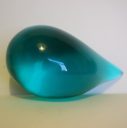

Collaboration has presented some rich ideas and listening to artists who are new to my work has given me perspective and has been a lifeline during this isolating time. Understanding what motivates other artists is inspiring.
The results of the collaborations manifest in many different ways. I thought initially the most effective would be working with scientists and people whose role was outside of art. This is something I love and will continue to do. I am discovering however that working with artists is challenging and presents obstacles which when tackling, results in my learning so much about my own work and the direction in which it is going. I think that I derive a lot of feedback which I would have had in group crits at Uni, and subsequently at the studio, but have not happened because of lockdown.
Where does a crit or chat about art work end and collaboration begin? For me it begins with a shared experience or joint subject and the agreement to continue to make work and bring it together (using a google document and Zooms), being influenced and working from each others work and continuing the dialogue of discovery. This is where I feel my practice changes for the better, trying something new or being reminded of an artist I had studied in the past but hadn’t realised the impact of this evident in my work. Listening to an artist describe the narrative in their work and their understanding of mine always uncovers something surprising.
Combining images purposefully is not something I have done before and it is harder than I imagined. I found myself thinking about the artist and their response as I would normally do with the viewer.
Here are some examples of the very different collaborations that I am involved with:
The XCollab are a new group who are pairing artists/students to create and exchange a piece of work individually which provides the influence for the final piece from each participant. The organisation issues guidelines and a time constraint, which presented new challenges. The final two individual pieces from each pair had to demonstrate the other’s work clearly and it had to be based on the colour blue. It could be a continuation of existing work.
I had been remaking an image of Salford Quays in which the bridge is reflected in the Quay West building. I worked in Tilt Brush and as the sky was blue with a deeper coloured block in the grid of the building it seemed to fit the brief.
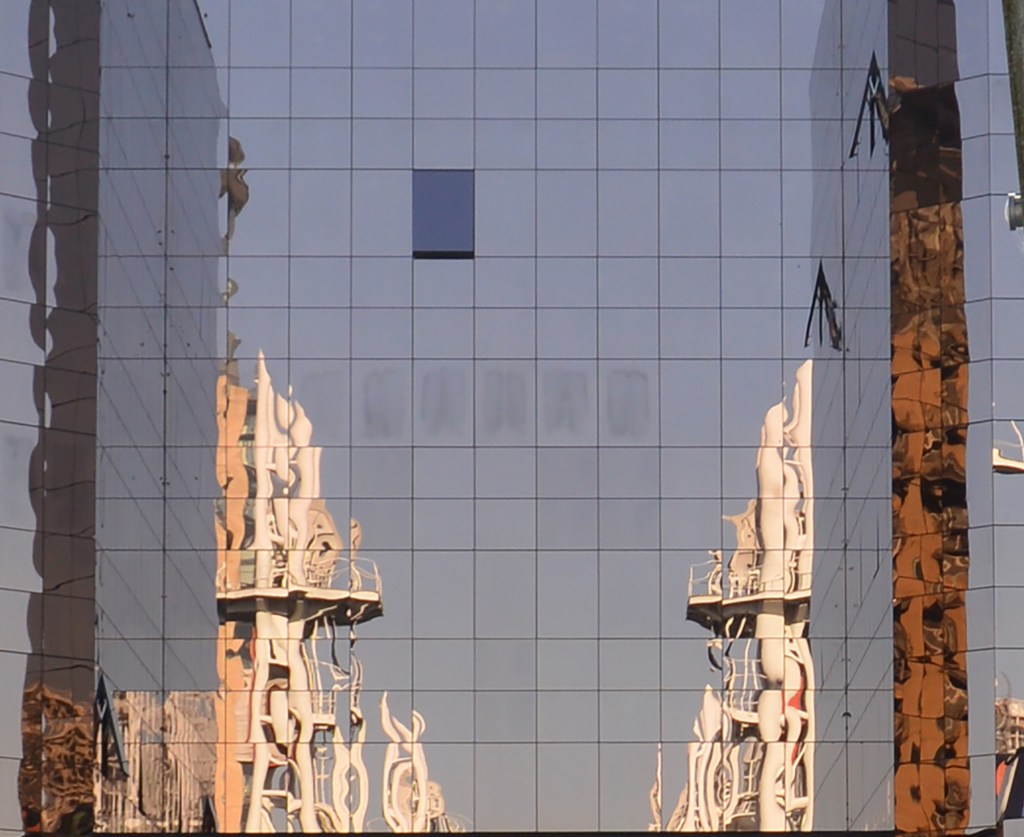
I explored the colours and shapes, using a grid as a layer and the mirror tool to create the two sides of the bridge, I recall the shimmering of the glass which is not evident on the photo but which became my focus. There were four layers to create depth and light.
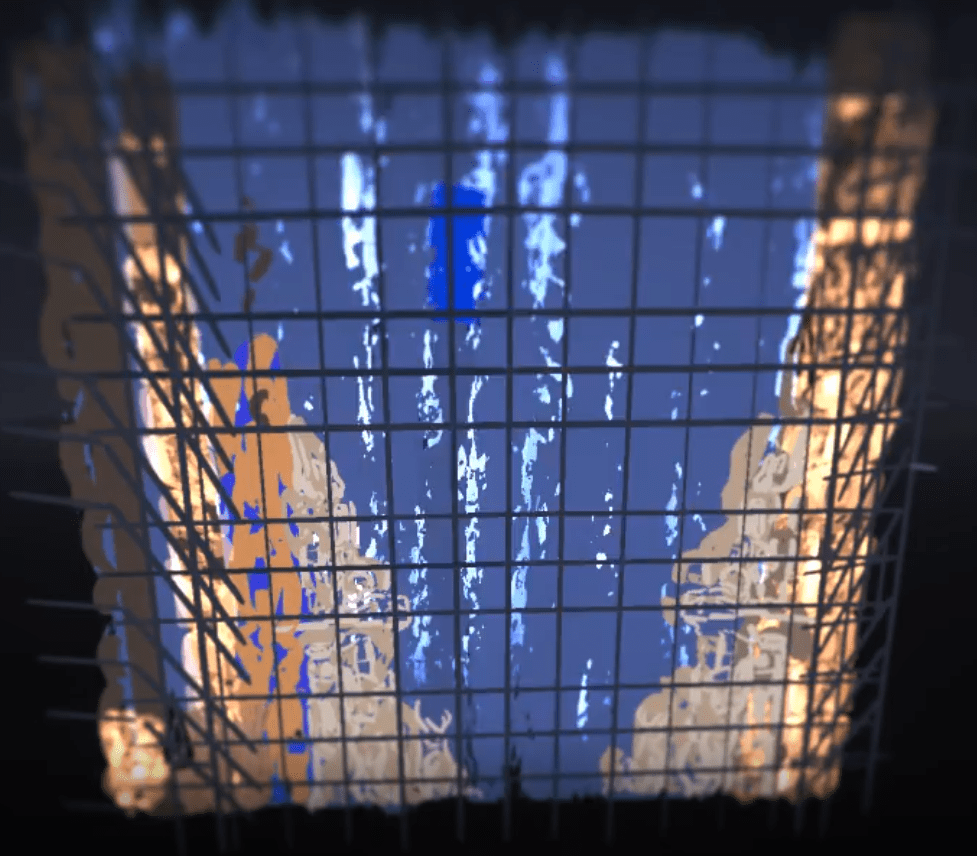
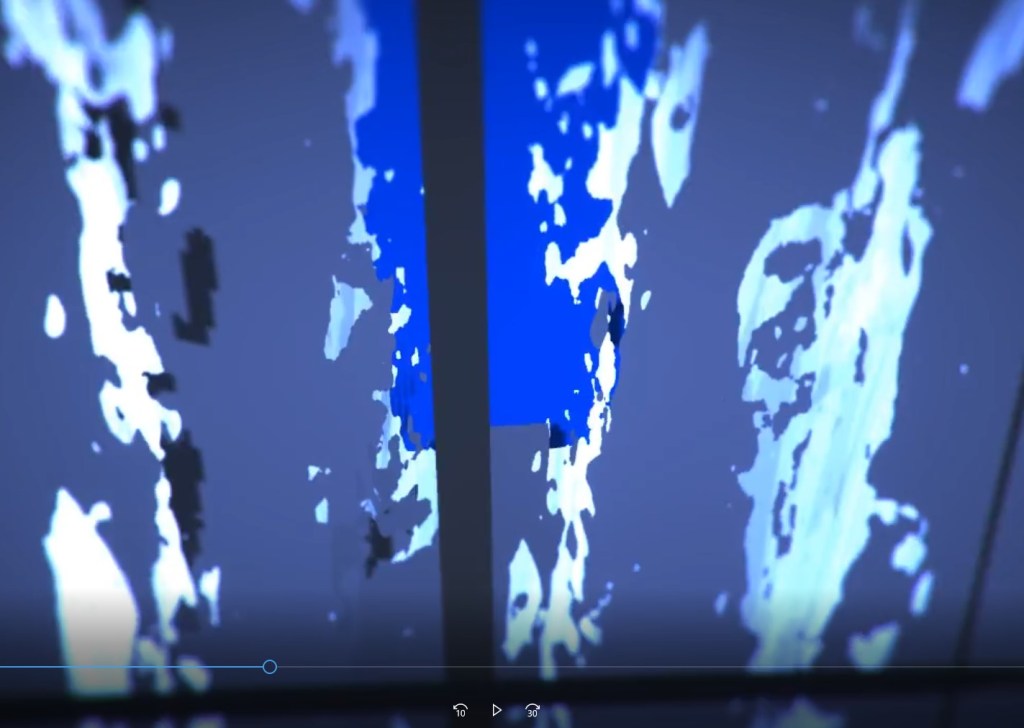
Screen Grabs from VR Filmed in Tilt Brush
I was introduced to Margo Sulek who is studying Structural Engineering and Architecture at The University of Sheffield, and is a talented artist looking to study art in the future. We believe that the organisers saw a correlation between our work, we got on really well and chatted before and during making the work. Margo made an ink drawing of a church combined with modern housing. The turret was flipped so that the spire pointed downwards. This reminded me of Takahiro Iwasaki’s intricate architectural structures in the Venice Biennale 2017, in wire and plywood, which were formed underneath from a mirror image of the top of the building.

The xCollab
The final two pieces of our work will be exhibited by The XCollab in the near future.
Collaborating with Tannah Cantrell
Tannah is this year’s Bursary winner at Paradise Works studio where I am based. Her rich oil paintings are figurative and display an interaction between people and objects. I worked with one of these paintings and a suggested title: I missed my friends, to re present the image in Tilt Brush VR.
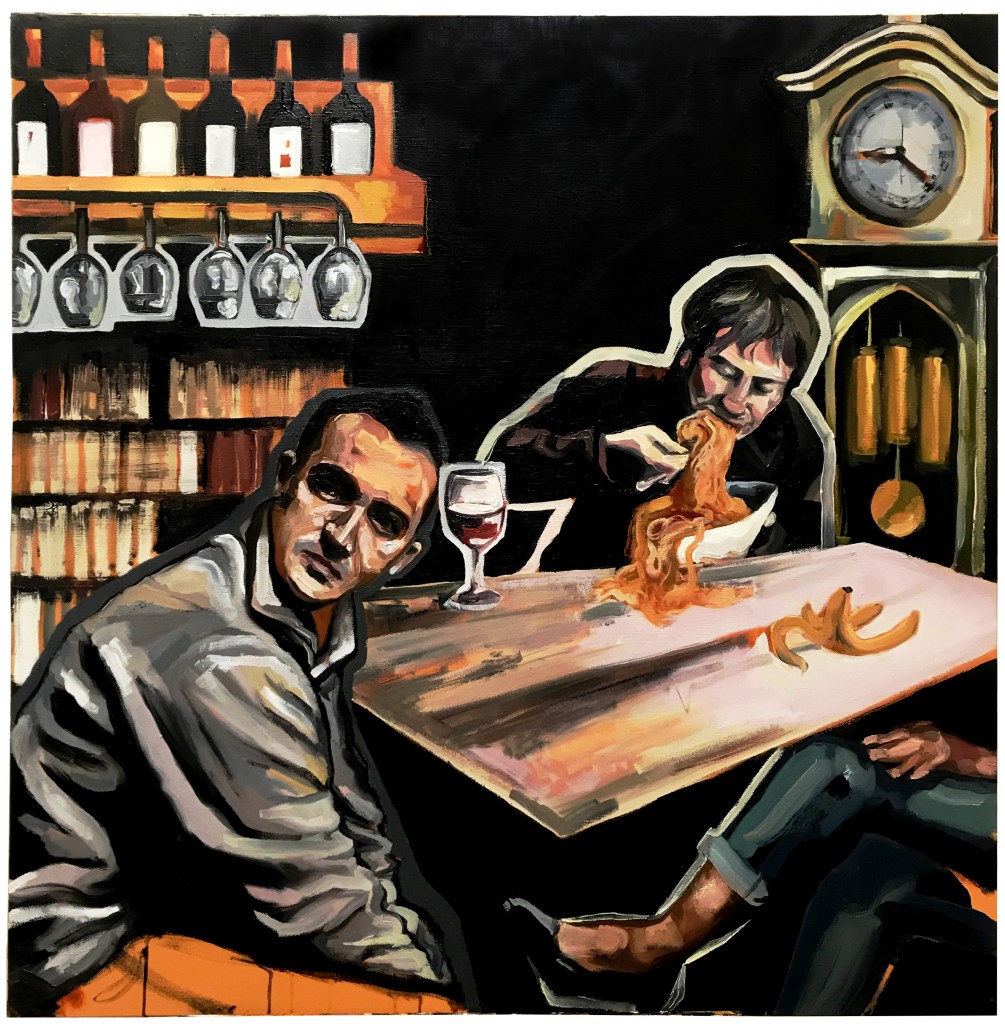
I hadn’t worked figuratively in VR but the accompanying quote resonated with me and I separated the background making it sketchy as if it were a plan not unlike those we want to make during lockdown. Then I reproduced the main figure with his tilted head gradually falling to represent the sadness and futility of our current circumstances. The canvas became a black cloud and although I am still working on the resolution quality for stills in VR you can see the shadow of the faces as they fall.
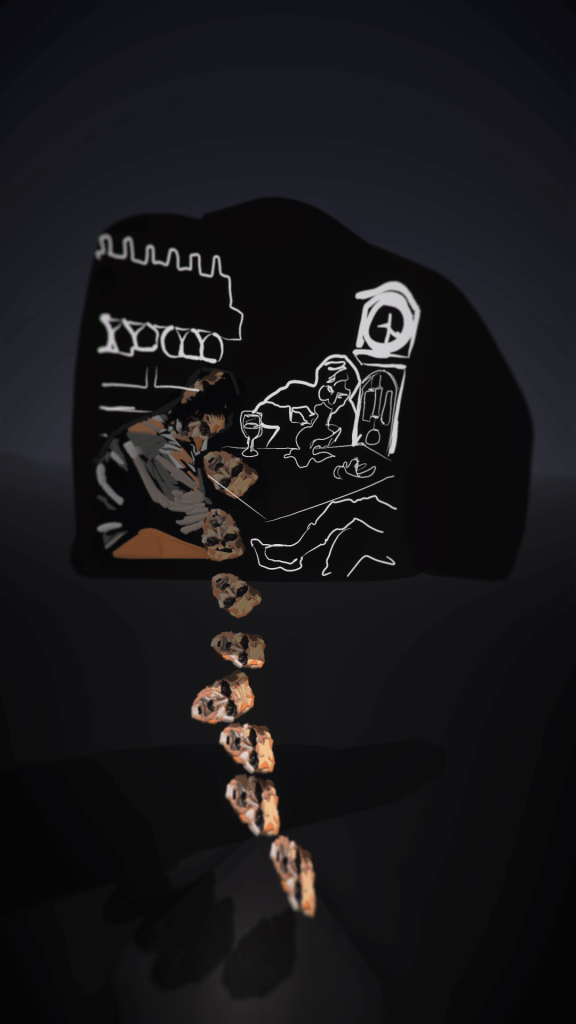
This collaboration was an exercise just for fun. It made me think differently about the possibility of making figurative work, and Tannah loved the shift from the painterly to sketchy and the falling head. I am looking forward to seeing what she does next. The wonderful thing about this type of collaboration is that there are no time constraints or restrictions, just a framework which can be adjusted to suit ourselves and current or experimental work. I have enjoyed attempting to replicate the deep colours and brush strokes in her work and learning about how she paints. The possibility of making some of the image as a sketch or plan will definitely feature in my work going forward. Watch this space!
 Babs Smith Multidisciplinary Artist