
Whilst in quarantine I have decided to look back at the artists who I think have influenced my work. I believe influence comes in strange and unexpected ways. There are the artists who’s work ‘I like’ and those whose I respect immensely. There are those whose work resonates with me and those whose practice and methodology ring true as similar to my own. I don’t prefer a painter or sculptor for their work specifically, I am drawn to process. I seem to have been influenced by an equal amount of male to female artists which I will prove or disprove as this blog continues. I will also have to decide which artists work I can recognise the influence of in my own work or process. I imagine the method of anyalysing this influence is dependent on the degree to which I investigated them and what I was drawn to at the time. Artists such as William Kentridge who’s exhibition was all encompassing and which documents his work in the form of film and books not to mention an excellent commentary that makes all of his work ‘art,’ surly would have entered my subconsious on many levels. And then there are the artists whose work I revisit to consider new work of, or look at from a different perspective. There are also Tutors and Technicians who have their own practice and guide us to consider artists that they have been influenced by. This is not going to be easy but I hope it helps me to see where there might be holes in my research as I come to the end of the term, at home, isolated, but with a new perspective. My method of research needs to be reconsidered if I am to grow as an artist, to default to the same methods with each new project cannot be conducive to growth?

60 cm x 55 cm
This work made during my second year, was influenced by Ethiopian born American Julie Mehretu’s Politicised Landscapes. I was drawn to her method of adding layers by using a system of shapes that had an almost scientific method of coalescing on the canvas and creating an explosive moment captured in time. The depth of the work is created with staggered movements and piercing lines on which the Artist meditates in a time consuming process of making. There is meaning in each of the marks as they represent unrest and reference specific observations: smashed glass shards, communication cables and uprooted trees observed in uprisings. I liked the scale of the work some canvases are as big as the inside of a church. I am drawn to the collaborative element such as the inclusion of a Jazz musician and his interpretation. Mehretu references David Hammond, Yves Klein and graffiti gestures on New York Trains in the 80’s. Paintings by Christopher Wool, whose brushwork and work with stencils is evidenced in Mehretu’s landscapes. The artist also mentions the sculpture of Huma Bhabha whose grotesque disfigured forms are made with found objects and whose drawings hold an energy in their thick strokes and layers that again we can see manifest itself in Mehretu’s work. Some marks remind you of Picasso and reference Abstract Expressionist Philip Guston. Mehretu points out that artists are constantly using these marks. The challenge of referencing the dangerous and the ugly provides the energy for the work. I myself am considering a geographical area in Substratum (above) that I have become familiar with and indeed fond of. I am portraying different periods of time as they exist in one place. This is a much less dangerous landscape at Salford Quays.
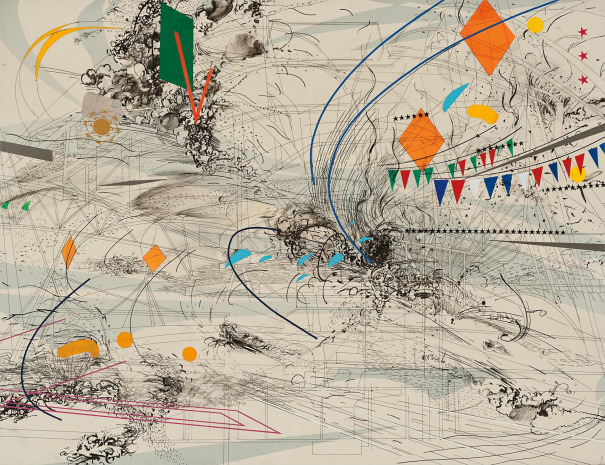
Julie Mehretu Stadia Excerpt (a small resurgence)
2004 ink, acrylic on canvas, laid over wood panel
36 x 47 in. (91.4 x 119.4 cm)
 Babs Smith Multidisciplinary Artist